How to Optimize Your LinkedIn Profile That Attracts Recruiters in 2026
TL;DR: If recruiters are not reaching out to you on LinkedIn, it is almost always a keyword and positioning problem, not an experience problem. Optimizing your headline, about section, and experience entries around your target role is what makes you findable and hireable.
If recruiters are not reaching out to you, your LinkedIn profile may be the reason. You can have a strong resume, solid experience, fifteen years of results, and still be completely invisible online. That is a frustrating place to be, especially when you know the work is there.
Recruiters do not scroll randomly through LinkedIn hoping to stumble on someone great. They search. They type in a job title, a skill set, and an industry keyword, and they look at who shows up. If your profile is not built around the language of your target role, you are not showing up in those searches, full stop.
The good news is that LinkedIn optimization is not complicated. It is strategic. This post breaks down exactly how to build a professional LinkedIn profile that attracts recruiters in 2026, step by step.
How Recruiters Actually Use LinkedIn
Before you can optimize your profile effectively, it helps to understand how the other side of the process works. Most job seekers think of LinkedIn as a place to post their experience and hope someone notices. Recruiters experience it as a search engine.
When a corporate recruiter or headhunter is filling a role, they open LinkedIn Recruiter, type in a combination of keywords, filter by location and experience level, and work through the results. The profiles that surface are the ones with the right keywords in the right places. The ones that do not surface simply do not exist to that recruiter, regardless of how good the experience behind them is.
Beyond search, recruiters who do land on your profile are scanning in a specific order. They read your headline first. If it does not immediately signal relevance to what they are filling, many of them stop there. If the headline works, they move to your About section to get a quick sense of who you are and what you bring. Then they glance at your most recent role to see if the experience matches. Then, in many cases, they look at your recent activity to see whether you are actually engaged on the platform or just parked there.
If your LinkedIn profile does not match what recruiters are searching for, they will never find you. And if they do find you, but the headline and about section do not land quickly, they will move on in about thirty seconds.

Step 1: Choose a Clear Target Role
This is where most corporate professionals go wrong before they even get to the writing. Their LinkedIn presence is built around where they have been rather than where they are going. Their headline says something like "Senior Leader with Broad Experience" or, even vaguer, "Open to Opportunities." Their about section covers multiple possible directions. Their profile reads like a general career summary rather than a positioning document.
The problem is that vague profiles do not rank for anything specific. When a recruiter searches for a "Director of Operations" or a "VP of Marketing," LinkedIn's algorithm surfaces profiles that clearly signal those roles. A profile optimized for everything is effectively optimized for nothing.
Pick one primary target role. This does not mean you will only ever be considered for that exact title. It means your profile is anchored clearly enough that the right recruiters can find you and immediately understand your value. Clarity attracts. Vagueness gets scrolled past.
Once you have chosen your target role, that language needs to show up in your headline, your about section, your experience descriptions, and your skills. You are building a consistent signal across the whole profile.
Step 2: Optimize Your Headline and About Section
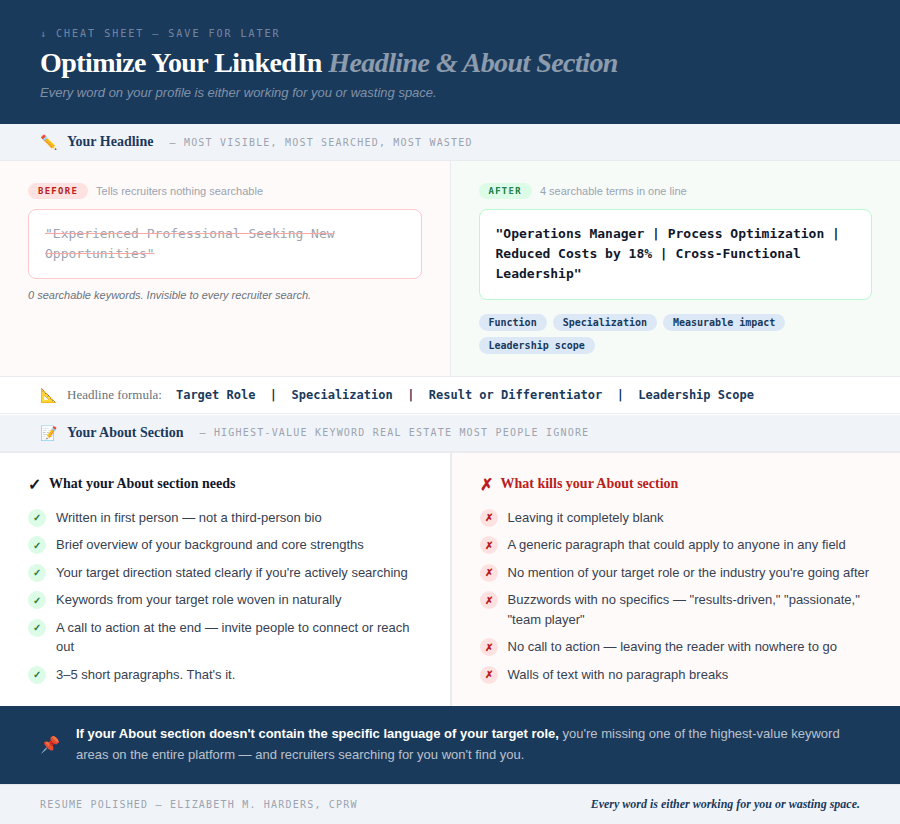
Your headline is the single most important line on your LinkedIn profile for search visibility. It is what shows up in search results, in recruiter searches, and when your name appears in someone's feed. Most people waste it.
The default LinkedIn headline is your current job title and company. That is fine as a starting point, but it is not optimized for anything. An effective headline for someone in a job search includes your target role or primary identity, two to three core skill areas or specializations, and, where possible, a specific result or point of differentiation.
Instead of: "Experienced Professional Seeking New Opportunities"
Use something like: "Operations Manager | Process Optimization | Reduced Costs by 18% | Cross-Functional Leadership"
That second version tells a recruiter your function, your specialization, your impact, and your leadership scope in one line. It also contains four separate terms a recruiter might search for. Every word is doing work.
Your About section is your next priority. This is where you write in first person, give a brief overview of your background and strengths, state your target direction if you are actively searching, and drop in additional keywords naturally. Think of it as a slightly expanded version of your resume summary. Three to five short paragraphs is enough. End it with a call to action, something like "Open to connecting with opportunities in operations leadership" or a direct invitation to reach out.
One thing I see constantly: About sections that are either blank or filled with a generic paragraph that could apply to anyone in any field. If your About section does not contain the specific language of your target role, you are missing one of the highest-value keyword real estate areas on the entire platform.
Step 3: Showcase Results, Not Responsibilities
This is the same principle that applies to a strong resume, and it is just as important on LinkedIn. The difference between a profile that generates recruiter interest and one that sits quietly in search results is almost always the presence of measurable results.
Recruiters scanning experience sections are looking for evidence of impact. Revenue growth, cost reduction, efficiency improvement, leadership scope, and project scale. They want to see what changed because of what you did, not just a list of what you were responsible for.
"Managed a regional sales team" is a responsibility. "Led a regional sales team of twelve, growing territory revenue by 31 percent over eighteen months" is an accomplishment. The second version does something the first one does not: it answers the question every recruiter is quietly asking, which is "what will this person actually produce for us?"
Go through your three most recent positions on LinkedIn and audit every bullet point. Ask yourself whether each one shows an outcome or just a duty. If it is only a duty, either add a result or replace it. If you do not have an exact number, use approximations or qualitative markers. "Significantly reduced" is weaker than "reduced by 22 percent," but it is still stronger than just "reduced."
The profiles that generate the most recruiter inbound are the ones where the evidence of impact is immediate and specific. You do not need to overhaul your whole career history. Getting your three most recent roles right moves the needle the most.
Step 4: Build Credibility Through Activity
Here is the part most corporate professionals skip entirely, and it is one of the most underutilized advantages on the platform. LinkedIn is not just a database. It is a social platform with an algorithm that rewards activity.
Profiles that post, comment, and engage consistently get shown more broadly in the feed and tend to rank higher in searches over time. More practically, when a recruiter lands on your profile and sees recent, thoughtful activity, it signals that you are engaged, current, and plugged into your industry. A profile that has been dormant for two years reads differently from one where the person was posting insights last week.
You do not need to post every day or become a LinkedIn influencer. A realistic approach for a busy professional is one to two short posts per week, plus five to ten genuine comments on content in your industry or field. The posts do not need to be long. A two-paragraph observation about something happening in your industry, a brief lesson from a project you worked on, a question to your network about a relevant challenge. Short, specific, and genuine consistently outperforms polished but infrequent.
The goal is a visible, credible digital presence that reinforces what your profile says about you.
Common LinkedIn Mistakes That Make You Invisible
These are the patterns that keep showing up on profiles that are not generating recruiter interest, even when the underlying experience is strong.
No keywords in the headline, about section, or experience entries means search algorithms cannot surface you for the roles you want. A generic summary that does not speak to a specific role or industry tells recruiters nothing useful and fails to hold their attention. No results in your experience section removes the evidence of impact that separates strong candidates from average ones.
An outdated photo is worth mentioning because it does affect perception. Your photo does not need to be professional headshot quality, but it should be recent, clear, and professional enough that it matches the level of role you are pursuing. A blurry photo from five years ago, or worse, no photo at all, reduces profile views significantly because LinkedIn's algorithm deprioritizes incomplete profiles.
No banner image leaves a blank gray space at the top of your profile that makes it look like an afterthought. The banner is a free visual opportunity to reinforce your brand or your field. Even a clean, simple graphic is better than the default blank.
Inconsistent tone between your profile sections, for example, a formal experience section paired with a casual, unfocused about section, creates a fragmented impression. The whole profile should feel like it was written by the same person with the same clear purpose.
When to Invest in LinkedIn Branding for Corporate Professionals
Small tweaks to your headline or about section are a good starting point. But for professionals targeting $100K-plus roles where competition is higher, and the hiring process is more scrutinized, the difference between a passable profile and a strategic one is significant.
If you have been actively searching and recruiters are not reaching out, if you have updated your profile a few times and it still does not feel like it is working, or if you are making a career transition that requires repositioning your entire online presence, that is when more comprehensive support makes sense.
My LinkedIn Branding for Corporate Professionals service is built around exactly this: strategic positioning, keyword alignment, and leadership visibility. Not just a rewrite of your existing content, but a deliberate repositioning of your profile to attract the right opportunities at the right level.
How Career Coaching Strengthens Your LinkedIn Strategy
LinkedIn optimization does not exist in isolation. A strong profile is more effective when it is paired with clarity about your target role, a resume that tells the same story, and a plan for how you are going to leverage the inbound interest you generate.
LinkedIn optimization works best when combined with a clear target role and positioning strategy, interview preparation so you are ready when the recruiter calls, an active networking approach that supplements what the algorithm surfaces, and salary positioning so you know your number when the offer conversation starts.
That is where career coaching comes in. My Job Search Bootcamp brings all of those pieces together into a cohesive job search strategy, so you are not just visible on LinkedIn but fully prepared to convert that visibility into offers.

About Career Coach and Author
Hi, I’m Elizabeth Harders. I’m a former recruiter turned career strategist who has spent years on the other side of the hiring table. I’ve seen thousands of resumes and cover letters, some great, most forgettable. Now, I help professionals craft applications that actually stand out and lead to interviews.
My specialty? Helping ambitious professionals land six-figure roles at Fortune 500 companies. Whether it’s fine-tuning a resume, optimizing a LinkedIn profile, practicing for an interview, or crafting a powerful cover letter, I make sure my clients present themselves as the best possible candidate for the job they want.
If you’re tired of sending applications into the void, book a free career strategy session.
FAQ: LinkedIn Profile That Attracts Recruiters
What should I put in my LinkedIn headline?
Your headline should include your target role or primary professional identity, two to three core skills or specializations, and if possible, one specific result or differentiator. Use the language of your target industry, not a personal tagline. The headline is a search field as much as it is a description.
How often should I update my LinkedIn profile?
Review your profile every three to six months at a minimum, and any time your target role shifts. Beyond that, keep your activity current by posting or commenting regularly. The algorithm favors active profiles, and recruiters notice when a profile has been updated recently versus sitting unchanged for a year or more.
Does LinkedIn really help you get hired?
Yes, especially at the corporate and mid-to-senior level. A significant number of corporate roles at the $80K and above range are filled through recruiter outreach that begins on LinkedIn. Professionals with optimized profiles regularly receive inbound messages for roles they never applied to. The platform is genuinely one of the highest-leverage tools in a job search when it is used strategically rather than passively.
Key Takeaways
Recruiters use LinkedIn as a search engine. If your profile does not contain the keywords tied to your target role, you are invisible to their searches, regardless of your experience.
Your headline is the highest-priority element for search visibility. Make it specific: target role, core skills, and a measurable result where possible.
Results beat responsibilities everywhere on the platform. Audit your experience sections for accomplishments, not just duties.
Consistent activity builds credibility and algorithmic visibility. You do not need to post every day, but you need to be present.
A professional LinkedIn profile that attracts recruiters is not just a polished resume copy. It is a strategically built positioning document that speaks directly to the roles and the people you want to reach.
Ready to Build a LinkedIn Profile That Actually Gets You Found?
LinkedIn Branding for Corporate Professionals: See the service
Career Coaching Program: Learn more
Free Strategy Session with Elizabeth: Book here