Gaps in Resume: How to Explain Employment Gaps Without Hurting Your Chances
TL;DR: Employment gaps on a resume do not disqualify you. What matters is how you frame them. A brief, confident explanation that pivots to growth is almost always enough to move past a recruiter's concern.
If you have gaps in your resume, you are probably worried that recruiters are going to judge you for them. That worry is understandable, but it is also bigger than it needs to be. Career breaks happen. Layoffs happen. Health situations happen. Family needs happen. Life happens, and hiring managers know this.
The real issue is not the gap. It is how you explain it. A gap with no context reads as avoidance. A gap with a clear, confident explanation reads as self-awareness. Those two things land very differently in a hiring process, and the difference between them is almost entirely about framing.
Here is everything you need to know about handling employment gaps on a resume without it costing you the opportunity.
Do Employment Gaps on a Resume Matter?
The honest answer is: yes, recruiters notice them. And no, they are not an automatic rejection.
Most experienced hiring managers have seen enough resumes to know that careers are not perfectly linear. People get laid off. They take time for caregiving. They deal with health issues. They go back to school. They relocate. A gap on a resume is a question mark, not a stop sign. The question it raises is simple: what was going on, and is this person ready to perform now?
What you do not want is to leave that question unanswered. Because when there is no explanation, the recruiter fills in the blank themselves, and their version is usually less generous than yours.
What Actually Raises Red Flags
Three things tend to make recruiters more concerned about a gap than the gap itself warrants.
The first is no explanation at all. A two-year gap with zero context is unsettling, not because of the time, but because it signals either a lack of awareness or an attempt to hide something. Neither reads well.
The second is inconsistent dates. If the dates on your resume do not add up, or if you have clearly fudged them to minimize the appearance of a gap, that creates a trust problem that is worse than the gap ever would have been.
The third is a defensive tone, either on the resume or in the interview. If you bring up the gap and immediately launch into a lengthy justification, it signals that you are still carrying anxiety about it. Confidence and brevity communicate that the gap was a chapter, not a crisis.

How to Explain Employment Gaps on a Resume
The goal is simple: acknowledge the gap, frame it neutrally, and move on. You do not need to write a paragraph about it. You need one clear line that answers the question before anyone has to ask.
Option 1: Add a Brief Note Under Your Most Recent Role
If the gap follows your last position, you can add a single line under that job entry. Something like
"Left position to focus on family caregiving" or "Departed following company-wide layoff." Clean, factual, done.
Option 2: Create a "Career Break" Entry
This is one of the cleanest approaches, especially for longer gaps. You list it as its own line item in your experience section with dates and a one-line description.
"Career Break | 2022-2023 | Focused on personal health and professional development" is professional, transparent, and completely normalized. LinkedIn even has an official Career Break category now. The format itself is no longer stigmatized.
Option 3: Address It Briefly in Your Cover Letter
If the gap is significant or recent, one to two sentences in your cover letter can preempt the question entirely. Keep it factual, keep it brief, and pivot directly to your readiness and enthusiasm for the role. You are not asking forgiveness. You are providing context.
The through line in all of these: short, confident, forward-facing. No essays.
Where to Put Work Delays on a Resume
One of the more specific questions people search for is exactly where on the resume a gap or work delay should appear. Here is how to think about placement.
Under the Experience Section
For most gaps, this is the right place. Your experience section already contains your timeline. A Career Break entry fits there naturally, listed in reverse chronological order just like everything else. It looks intentional because it is.
As Its Own Line Item
If the gap was long enough that leaving it blank would create an obvious date hole, give it its own entry. Treat it the way you would treat any other position: title-style label, dates, and a brief one-line description. This is the most transparent approach and usually the most effective one.
In Your Summary, If Necessary
If you are returning to the workforce after a significant gap and want to address it proactively at the top of your resume, a single sentence in your summary can work. Something like "Returning to full-time work following a two-year career break focused on caregiving and professional development." Brief, clear, and it takes the question off the table before anyone asks.
Sample Resume With Gaps in Employment
Here is what a resume entry looks like when a gap is handled cleanly and confidently. This is the format that works.
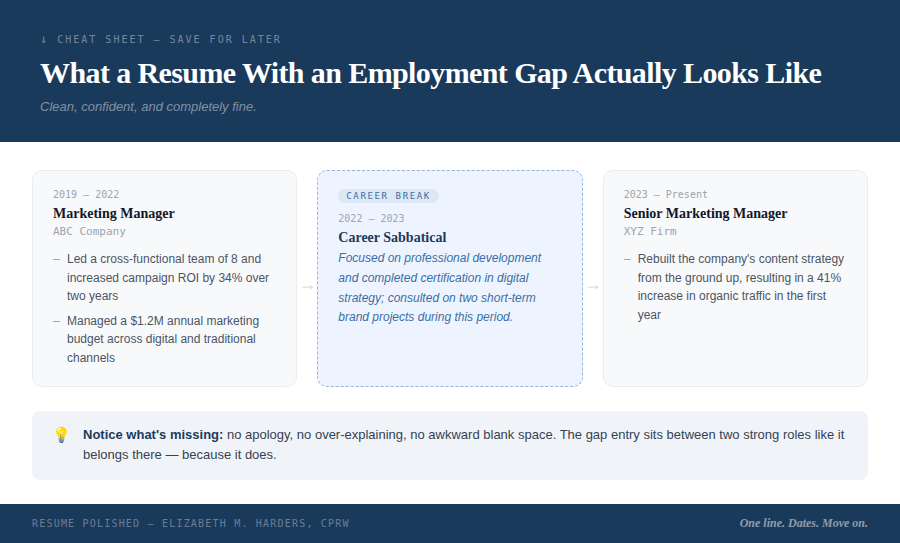
Marketing Manager ABC Company | 2019 – 2022
Led a cross-functional team of eight and increased campaign ROI by 34 percent over two years.
Managed a $1.2M annual marketing budget across digital and traditional channels.
Career Sabbatical 2022 – 2023 Focused on professional development and completed certification in digital strategy; consulted on two short-term brand projects during this period.
Senior Marketing Manager XYZ Firm | 2023 – Present
Rebuilt the company's content strategy from the ground up, resulting in a 41 percent increase in organic traffic in the first year.
Notice what that looks like. The gap is not hidden. It is not apologized for. It is listed with the same professional tone as every other entry on the page. The one-line description does just enough to answer the question without turning the gap into the focus of the resume. That is the goal.
How to Talk About Employment Gaps in Interviews
Even if your resume handles the gap well, a recruiter or hiring manager is likely to ask about it in conversation. Having a prepared answer matters because an unprepared answer tends to come out defensive or rambling, which is exactly what you want to avoid.

The Formula That Works
Keep it factual. Keep it brief. Pivot to growth. Redirect to your value.
That is the whole structure. Here is what it sounds like in practice:
"I took time off after a layoff to complete advanced certifications and reassess my long-term goals. During that time, I also consulted on two short-term projects. I am now fully focused and excited to bring that experience into my next role."
That answer is maybe thirty seconds long. It explains the gap without dwelling on it. It demonstrates that the time was not wasted. And it ends by pointing forward, which is where the interviewer's attention should be anyway.
One thing I worked on with a client who had taken a fourteen-month gap for a serious health issue: she kept wanting to over-explain the medical details because she thought she needed to justify the length of the break. What we found through practice was that the more she explained, the more unsettled the interviewer seemed. When she tightened it to one sentence and immediately pivoted to what she did during her recovery, including an online certification and some freelance writing, the response was completely different. People were not asking follow-up questions. They were moving on to the actual interview.
The Biggest Mistakes People Make With Gaps in a Resume
Most of these come from anxiety about the gap, which is understandable. But the anxiety itself tends to produce the behaviors that cause the most damage.
Overexplaining
A paragraph on your resume about why you left the workforce, a lengthy cover letter section devoted to the gap, or a five-minute answer in an interview all have the same effect: they make the gap the centerpiece of your candidacy. It should be a footnote, not a headline.
Blaming a Former Employer
If the gap followed a difficult departure, the instinct to explain the context is natural. But bringing negativity about a past company or manager into the explanation always backfires. Keep it professional and forward-facing regardless of what the circumstances actually were.
Sounding Defensive
The moment you sound defensive, the recruiter's concern goes up. Defensiveness signals that you believe the gap is a bigger problem than it might actually be. A calm, matter-of-fact tone communicates the opposite.
Not Showing Any Growth
The gap does not have to have been a period of professional development to be explained well. But if you can point to anything, a course, a certification, a volunteer role, a consulting project, even consistent reading in your field, include it. It shows that you stayed engaged, which is what most employers are actually looking for.
Are Employment Gaps Worse Than Job Hopping?
This comes up a lot, and the answer is: not necessarily. Both raise questions. Neither is automatically disqualifying. The thing they have in common is that both require a good explanation.
A candidate who changed jobs every eight months for five years and has no clear narrative for why raises concerns about stability and follow-through. A candidate who has a two-year gap but a clear explanation and a strong track record raises much smaller concerns.
Context matters more than the pattern itself. Recruiters are trying to answer one underlying question: is this person going to show up, perform, and stay? A gap does not automatically undermine that. A job-hopping history can be problematic if it is not explained well. Neither is inherently more damaging than the other, which means neither should be treated as something that defines your candidacy.

About Career Coach and Author
Hi, I’m Elizabeth Harders. I’m a former recruiter turned career strategist who has spent years on the other side of the hiring table. I’ve seen thousands of resumes and cover letters, some great, most forgettable. Now, I help professionals craft applications that actually stand out and lead to interviews.
My specialty? Helping ambitious professionals land six-figure roles at Fortune 500 companies. Whether it’s fine-tuning a resume, optimizing a LinkedIn profile, practicing for an interview, or crafting a powerful cover letter, I make sure my clients present themselves as the best possible candidate for the job they want.
If you’re tired of sending applications into the void, book a free career strategy session.
FAQ: Gaps on Your Resume
Is it okay to quit a job after 6 months and put it on your resume?
Yes, include it. Leaving a short-term role off your resume might seem like it protects you, but it can create a gap or a date discrepancy that raises more questions than the short stint would have. List it, keep the description brief, and be prepared to explain it simply in an interview. "The role was not the right fit, and I made the decision to leave quickly rather than stay in something that was not working" is a perfectly acceptable answer.
Is a 2-year gap bad on a resume?
Not automatically, no. A two-year gap is long enough that it will get noticed and likely asked about, but it is not the career-ender most people fear it is. What matters is how you address it. A two-year gap with a clear, confident one-line explanation, especially one that mentions any professional development, caregiving, health, or other legitimate life reason, is something most experienced hiring managers will accept and move past quickly.
Key Takeaways
Gaps in your resume are noticed but rarely disqualifying on their own. How you frame them is what determines whether they become a problem.
Use a Career Break entry in your experience section to address gaps directly, with dates and a single line of context.
Never hide dates or use a functional resume format to obscure a gap. It signals avoidance and creates a trust issue that is worse than the gap itself.
In interviews, keep your gap explanation factual and brief, then pivot immediately to what you bring to the role.
A two-year gap, a six-month stint, a layoff, a health break, none of these are automatic rejections. Confidence and clarity in how you talk about them are what move you forward.
Want Help Positioning Your Resume the Right Way?
If you have gaps in your work history and want a professional review of how your resume is framing them, or you want a full strategy for your job search, here are a few ways to work with Elizabeth:
Free Strategy Session: Book here