Can't Get a Job After 100 Applications? Stop Mass Applying and Do This Instead
TL;DR: If you can't get a job despite being qualified, the problem is rarely your experience. It's your strategy. Mass applying doesn't work. Targeted positioning, a keyword-optimized LinkedIn profile, and proactive outreach do.
If you've been thinking, "I can't get a job" lately, you are not the only one. You've applied to 50, 80, maybe 200 roles. You're tailoring your resume, writing cover letters, refreshing your inbox every morning, and still nothing. You're starting to wonder, why can't I get a job if I'm qualified? It can start to feel like nobody wants to hire me. And that feeling is exhausting in a way that's hard to explain to people who haven't been through it.
Here's the direct answer to what's happening: the volume approach is not a strategy. It feels productive because you're doing something. But sending out mass applications to dozens of roles is one of the fastest ways to stay stuck. The job market, especially at the corporate and mid-to-senior level, does not reward the person who applies to the most jobs. It rewards the person who shows up as the most targeted, most clearly positioned candidate.
The rest of this post breaks down exactly why this keeps happening and what to do instead.
Why Can't I Get a Job Even Though I'm Qualified?
This is the question that haunts professionals who have been in the job search longer than they expected. And the frustrating part is that it has a real answer. It is not about the economy, and it is not about bad luck. There are specific, fixable reasons why qualified people keep getting passed over.
Mass Applying to Everything
When people feel desperate or stuck, the instinct is to apply to more things. More applications equals more chances, right? Not really. What actually happens is that your resume becomes generic enough to fit everything and compelling enough to win nothing. Hiring managers and applicant tracking systems are both filtering for relevance. A resume that tries to speak to every role ends up speaking clearly to none of them.
I had a client, a senior marketing professional, who had applied to over ninety roles in four months before we worked together. When I looked at her application history, she had applied to brand manager roles, digital marketing director roles, content strategy positions, and even a few communications roles that were a stretch. Her resume tried to cover all of it. As a result, it was impossible to tell at a glance what she actually did and where she was going next.
Not Targeting One Specific Role
Most people who say "I can't get a job" are applying to four or five different job titles at once. That makes sense emotionally. You want options. But it kills your positioning. Every time you shift your resume to fit a different title, you dilute the signal you're sending. Recruiters and hiring managers are looking for someone who is an obvious fit. Not someone who could maybe work in this department.
Resume and LinkedIn Are Misaligned
This is a silent killer that most people do not even realize is happening. Your resume says one thing. Your LinkedIn profile says something slightly different. Maybe your headline is vague. Maybe your experience descriptions are framed differently. Maybe your skills section does not reflect the keywords in the roles you're targeting. Recruiters and applicant tracking systems are matching keywords. If your LinkedIn and your resume are not telling the same focused story, you are creating friction that costs you opportunities.
No Proactive Networking
Most job seekers are 100 percent reactive. They wait for a job to be posted, apply, and wait again. The problem is that a significant portion of corporate roles, especially at the $80K to $150K and above range, are filled through referrals, internal movement, or direct recruiter outreach before a posting ever goes live. If you are only applying to posted jobs, you are only seeing a fraction of what is actually available.
If I were job hunting today, I would not send 50 applications. I would do three things immediately.
I Can't Get a Job. Here's What I'd Do Today
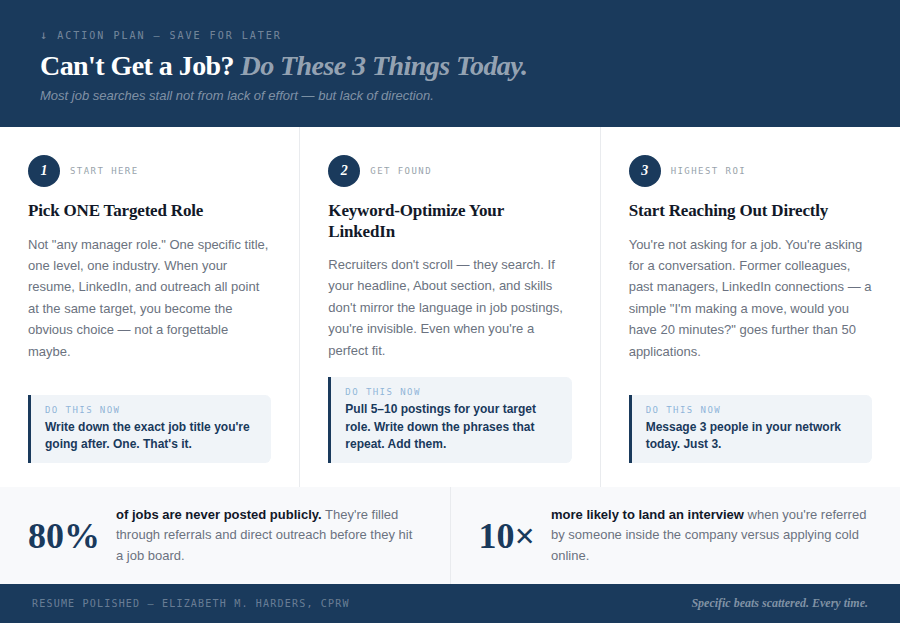
1. Pick ONE Targeted Role
Not "any manager role." Not "something in operations or maybe strategy." One specific, clearly defined next step. What is the exact title you are going after? What level? What industry? The more specific you get, the sharper your positioning becomes, and the faster things start to move.
This feels counterintuitive because it seems like narrowing down means closing off options. It actually does the opposite. When your resume, LinkedIn, and outreach are all pointed at the same target, you become the obvious choice for that role instead of a forgettable maybe for ten.
Most people who say "I can't get a job" are applying to five different job titles at once. Pick the one that is the clearest, most logical next step from where you are right now. Build everything around that.
2. Keyword-Optimize Your LinkedIn Profile
Headhunters and corporate recruiters do not scroll through LinkedIn hoping to stumble on someone great. They search. They type in a job title, a skill, an industry keyword, and they look at who shows up. If your LinkedIn profile is not loaded with the right keywords for your target role, you are invisible to that search, even if you are a perfect fit.
Your LinkedIn headline, your About section, your experience descriptions, and your skills section all need to mirror the language used in the job postings you're targeting. Pull up five to ten postings for your target role and write down the phrases that repeat. Those are the keywords that need to be in your profile.
Even if jobs are not posted, recruiters are searching. This is how you get found without applying to anything.
3. Start Reaching Out Directly
This one makes people uncomfortable, but it is probably the highest-return activity in any job search. Think through your actual network, not some abstract concept. Former colleagues. People you went to school with. Past managers who respected your work. Industry association contacts. LinkedIn connections you have not talked to in a while.
You are not asking for a job. You are asking for a conversation. Something like: "Hey, I'm making a move and targeting roles in X. Would you be open to a twenty-minute call? I'd love to hear what you're seeing in the market."
Most $100,000-plus roles are filled before they ever hit a job board. This is not an exaggeration. It is how hiring actually works at the corporate level. Even for mid-level professionals, referrals and direct outreach open doors that job boards simply do not.
Nobody Wants to Hire Me. Or Am I Just Invisible?
When the rejections pile up, or worse, when there is only silence after applying, it starts to feel personal. Like, there is something fundamentally wrong with you that employers are picking up on. That is a really painful place to be, and it is also almost never accurate.
It feels personal. It is usually positioned.
What reads to you like rejection is often just a positioning mismatch. Your resume is landing in the wrong pile, your LinkedIn is not showing up in the right search, or your application is getting filtered out before a human ever sees it. None of that is a reflection of your talent or your worth. It is a signal that something in your strategy needs to shift.
One client I worked with had been job searching for almost a year. She was convinced she was somehow unemployable at her level. When we sat down and reviewed her materials, her resume was solid, but her LinkedIn headline still reflected a job title from three years prior. Recruiters searching for someone in her target role literally could not find her. Two weeks after updating her profile with the right keywords, she had three recruiter messages sitting in her inbox.
That is a positioning fix.

What to Do If You Are Not Getting Any Job Offers for Years
This is for the person who has been searching for a long time. Months. A year. Longer. There are people who search for two or three years and cannot figure out what is going wrong. And yes, there are people typing "what to do if I am not getting any job offers for 15 years" into a search engine, and that question deserves a real answer.
If it has been that long, you do not need more applications. You need a full strategy reset.
That means looking at your resume positioning with fresh eyes. Is it speaking directly to a specific role and level, or is it just a general summary of your career? It means evaluating your LinkedIn in the same way. It means building a real outreach habit instead of waiting for postings. And it means getting outside feedback from a career coach, a mentor, or someone who hires in your field, so you can see what is not landing.
Long job searches are not always about the market. A lot of the time, they are about a message that is not connecting. Changing that message can shift the results faster than most people expect.
"I Can't Get a Job" Reddit Advice vs. Real Job Strategy
What Reddit Gets Wrong for Corporate Professionals
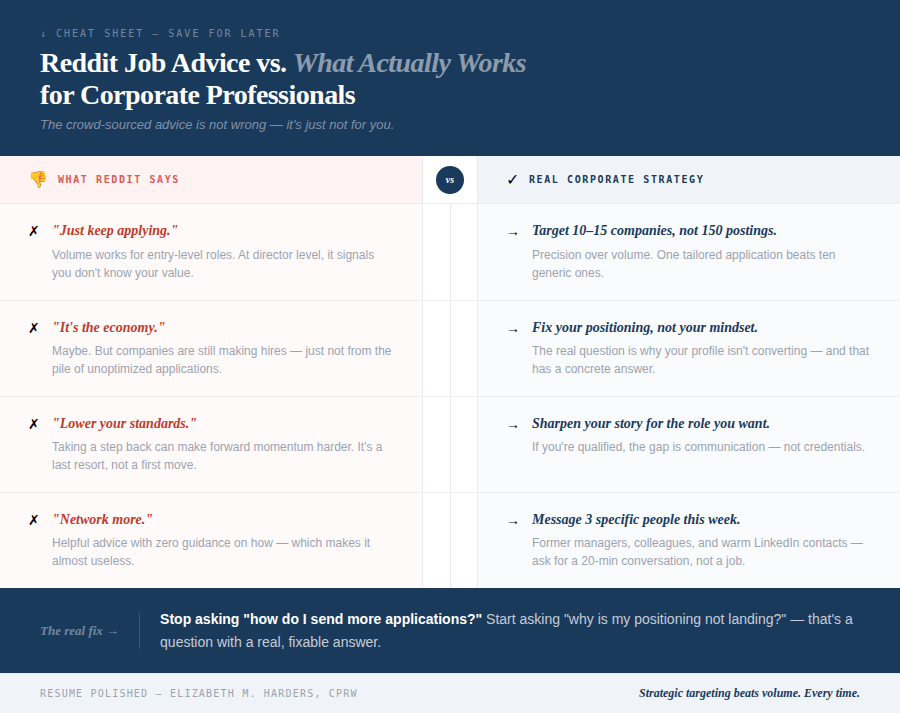
If you have ever gone down the rabbit hole of "I can't get a job" Reddit threads, you know the kinds of comments you find. Keep applying. It's the economy. Lower your standards. Network more, they say, without explaining what that actually means.
Some of that advice is fine for certain situations. But for corporate professionals trying to land mid-to-senior roles, it is mostly noise.
Reddit job search advice is crowd-sourced from people at all different career levels and circumstances. The person telling you to "just keep applying" may have found their entry-level role through volume. That same approach does not translate to a $120,000 director-level position where the hiring panel is more selective and looking for someone who clearly fits.
On Reddit, the advice often sounds like: keep applying, it's the economy, or just lower your standards. But for corporate professionals, that is not the fix. Strategic targeting is.
The real question is never "how do I send more applications?" It is "why is my positioning not landing," and that requires a different kind of answer.

About Career Coach and Author
Hi, I’m Elizabeth Harders. I’m a former recruiter turned career strategist who has spent years on the other side of the hiring table. I’ve seen thousands of resumes and cover letters, some great, most forgettable. Now, I help professionals craft applications that actually stand out and lead to interviews.
My specialty? Helping ambitious professionals land six-figure roles at Fortune 500 companies. Whether it’s fine-tuning a resume, optimizing a LinkedIn profile, practicing for an interview, or crafting a powerful cover letter, I make sure my clients present themselves as the best possible candidate for the job they want.
If you’re tired of sending applications into the void, book a free career strategy session.
FAQ: Why Can't I Get a Job?
What should I do if I can't get a job?
Stop applying to everything and pick one target role. Update your LinkedIn with the specific keywords from that role. Start reaching out to your network directly instead of only waiting for postings. If you have been searching for more than three months without traction, get outside feedback on your resume and LinkedIn before sending another application.
How do I stand out in a competitive job market?
Be specific. Generic candidates get filtered out. The person who stands out is the one whose resume speaks directly to the exact role, whose LinkedIn is loaded with the right keywords, and who can clearly show measurable results in an interview. Specificity is what separates people in a crowded applicant pool.
Is LinkedIn really important for getting a job?
Yes, especially at the corporate level. Recruiters use LinkedIn as a search tool every single day. If your profile is not optimized with the right keywords for your target role, you are not showing up in those searches at all. A strong LinkedIn profile generates inbound recruiter interest even when you are not actively applying anywhere.
Key Takeaways
Mass applying is not a strategy. Targeting one specific role and building everything around it is what actually moves the needle.
Your LinkedIn profile needs to be keyword-optimized for the role you want, not just a summary of where you have been.
Most corporate roles are filled through networks and direct recruiter outreach before a job posting ever goes live.
If the search has dragged on for months or years, the problem is almost always positioning, not your qualifications.
Feeling like nobody wants to hire you is usually a signal that your message is not connecting, and that is fixable with the right strategy.
Ready to Fix the Strategy?
If any of this sounds familiar and you want real feedback on what is not working, here are a few ways to work with Elizabeth:
Free Strategy Session: Book here
Career Coaching Program: Learn more
Resume Writing Services: See options