Career Change Resume: What to Include (and What to Leave Out)
TL;DR: A career change resume is not a list of everything you have ever done. It is a strategically reframed version of your experience that highlights transferable skills and results aligned with your new target role. The goal is relevance, not reinvention.
Writing a career change resume can feel overwhelming. You are switching industries. You do not have the exact job title they are asking for. And somewhere in the back of your head, you are wondering if anyone is going to take you seriously when your background does not line up perfectly with the job description.
Here is what most people in a career transition do not realize: Hiring managers do not expect clones. They expect relevance. The candidate who gets the offer is not always the one with the most directly matching title. It is the one who makes their experience feel like the most logical answer to the employer's problem.
Your experience is not the issue. The framing is. And framing is completely within your control.
This post walks you through exactly how to build a career change resume that positions you as a strong, credible candidate for the role you actually want.
What Is a Career Change Resume?
A career change resume is not the same as a standard chronological resume. The typical resume is essentially a career history, organized by time and title. It works well when you are staying in the same lane. It falls apart when you are switching directions.
A career transition resume is a strategically reframed document. The structure may look similar, but the emphasis is different. Instead of organizing your experience around what you did in each role, you organize it around what is relevant to where you are going. The lens changes. The goal is to make your past experience answer a specific question: why are you the right person for this new role?
This does not mean hiding your background or pretending your previous industry does not exist. It means shifting the spotlight onto the transferable skills, measurable results, and accomplishments that map directly onto your new target.
Your experience stays. The framing changes.

Resume Summary for Career Change (How to Write It)
The summary section at the top of your resume is the most valuable piece of real estate on the page, and in a career transition, it does a specific and critical job. This is where you take control of the narrative before the reader starts forming their own story about your background.
Most people either skip the summary entirely or write something so vague it communicates nothing. For a career change resume, a strong summary is not optional. It is the thing that answers the reader's first question before they even have to ask it.
Your Summary Must Do Three Things
It needs to state your target role clearly. It needs to highlight the transferable strengths that connect your past to your future. And it needs to show value.
Here is what that looks like in practice:
"Operations professional with 8+ years of experience leading cross-functional teams and improving process efficiency, now transitioning into project management. Known for delivering measurable results, improving workflows, and driving accountability across departments."
Notice what that summary does. It names the target role directly. It leads with a specific area of expertise. It uses language that project management hiring managers recognize and respond to. And it does not over-explain or apologize for the transition. It presents the pivot as a logical, confident next step.
That is the tone your summary needs to carry. Clear. Confident.
One client I worked with had spent twelve years in retail management and wanted to move into corporate training and development. Her original summary said something like "experienced retail professional seeking new opportunity in a people-focused role." That sentence told the reader nothing useful. We rewrote it to lead with her coaching and team development experience, reference the measurable performance improvements she had driven, and name L&D as her target. The summary alone changed how interviewers perceived her entire resume.
How to Format a Resume for a Career Change
One of the most common mistakes career changers make is defaulting to a functional resume format without understanding when it actually works. This format groups skills at the top and often minimizes or removes timelines, which can seem like a smart way to highlight capability over experience.
In practice, functional resumes are not inherently wrong, but they are often misused. When done poorly, they can create confusion or raise concerns for recruiters who are trying to quickly understand career progression and role relevance.
In the right context, a functional or hybrid format can be effective, especially when transitioning careers or repositioning experience. The key is not the format itself, but how clearly the resume communicates value, progression, and alignment with the role.
Chronological Format
In most cases, a reverse chronological format works best. Listing your most recent role first and working backward allows recruiters to quickly understand your career progression, scope, and relevance. Clear and accurate dates help hiring teams assess consistency and experience level without confusion.
However, there are situations where this structure needs to be adjusted. For candidates with frequent job changes or unconventional career paths, strict chronology can distract from value. In these cases, a more strategic format or selective presentation of dates can help keep the focus on skills, impact, and alignment with the role.
The goal is not to follow a format blindly, but to present your experience in a way that is clear, credible, and easy for the hiring team to evaluate.
Do Not Hide Your Experience
Your background is not the problem. A career changer who tries to obscure their history ends up looking evasive. Own where you have been. The goal is to show how it connects to where you are going, not to pretend it did not happen.
Emphasize Transferable Achievements
Go through every bullet point under each role and ask whether it connects to your new target. If it does, keep it and sharpen it. If it does not connect at all, cut it or minimize it. You are not trying to include everything. You are trying to include what is relevant.
Adjust the Language to Match the New Industry
Every industry has its own vocabulary. The skills you used in one field often have direct equivalents in another, but the words are different. A retail manager who "coached sales associates on product performance" is describing something that a corporate L&D professional would call "facilitated performance coaching for frontline teams." Same activity. Different language. The second version speaks to the new audience.
Career Transition Resume Example
This is one of the most searched questions related to career change resumes, so let's look at what the pivot actually looks like on the page.
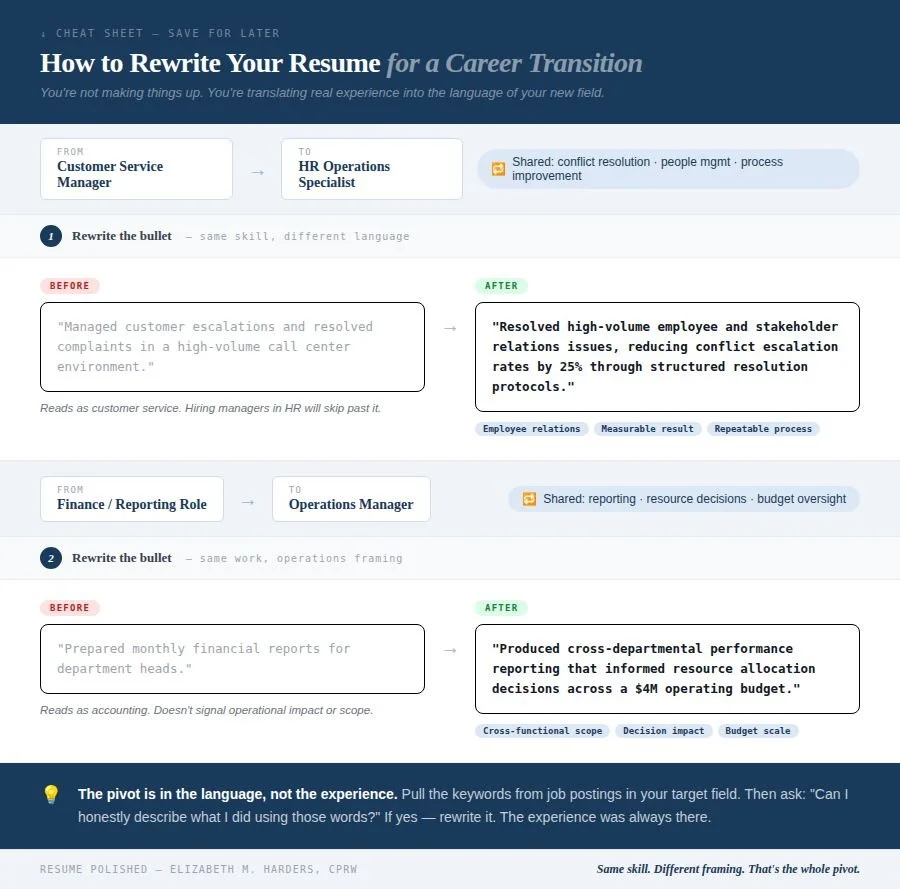
Former Role: Customer Service Manager, Target Role: HR Operations Specialist
These two roles share more overlap than most people realize. Both deal with conflict resolution, people management, process improvement, and team performance. The experience is there. The language just needs to shift.
Original bullet point:"Managed customer escalations and resolved complaints in a high-volume call center environment."
Rewritten bullet point:"Resolved high-volume employee and stakeholder relations issues, reducing conflict escalation rates by 25% through structured resolution protocols."
Same skill. Different framing. The second version speaks directly to what an HR operations team cares about: handling relations issues, reducing escalation, and doing it through a repeatable process.
That is the pivot. You are not making things up. You are translating your real accomplishments into the language of your new field.
Another example, this time from finance to operations management:
Original: "Prepared monthly financial reports for department heads."
Rewritten: "Produced cross-departmental performance reporting that informed resource allocation decisions across a $4M operating budget."
The underlying work was the same. The rewritten version speaks the language of operations, not accounting.
The Biggest Mistakes in a Resume for Changing Jobs
These are the patterns that consistently undermine career changers, even when their actual background is strong.
Saying "seeking a new opportunity in any field" is one of the most damaging things you can put on a resume. It signals a lack of direction and makes the hiring manager do the work of figuring out where you fit. You never want to hand that job to someone else.
Not stating your target role clearly is a close second. If someone reads your resume and cannot tell within ten seconds what role you are going for, you have already lost them. Pick a lane and name it in your summary.
Underselling transferable results is where a lot of career changers leave the most value on the table. They list responsibilities from their old field and assume the reader will make the connection to the new one. They will not. You have to draw that line explicitly.
Using objective statements from fifteen years ago, things like "seeking a challenging position that utilizes my skills," communicates nothing and dates your resume immediately. Replace it with a current, targeted summary statement.
And finally, not aligning LinkedIn with your resume. If your LinkedIn still reflects your old industry and your old positioning, recruiters who find your profile after seeing your resume are going to get a mixed message. Your LinkedIn headline, about section, and experience need to tell the same story your resume tells.
How to Convince Employers You're Not a Risk
This is the psychological layer of the career change resume that most people do not think about explicitly. Hiring managers considering a career changer are not just evaluating your skills. They are evaluating their own risk.
What Employers Are Actually Worried About
Commitment is the first concern. Will you stay if something in your original field opens up? Ramp-up time is the second. How long before you are actually contributing at the level we need? Training cost is the third. What do we have to invest to get you up to speed?
Your resume needs to quietly answer all three of these questions before they are asked.
You address commitment by being specific and confident about your target role. Vague positioning makes the commitment question louder. A clear, confident direction quiets it.
You address ramp-up time by showing overlapping skills. The more your experience visibly maps onto the new role, the shorter the perceived learning curve becomes.
You address training costs by leading with measurable impact. A candidate who has driven real, quantified results in other contexts has demonstrated that they know how to perform. That evidence crosses industry lines.
Confidence removes doubt. A resume that reads like you are unsure about the move creates uncertainty in the reader. A resume that presents the transition as the logical outcome of a deliberate career progression creates confidence.
Can You Change Careers Without Starting Over?
Short answer: yes.
Long answer: You reposition, you do not restart.
The fear most career changers carry is that switching fields means going back to entry level, accepting a pay cut, and essentially starting their career over from the beginning. For some very technical fields that require specific certifications or degrees, there may be a step back involved. But for most corporate and professional roles, the relevant experience you have built is real and it travels.
A senior marketing manager who moves into operations management is not starting over. She is repositioning twelve years of cross-functional leadership, budget management, and stakeholder communication into a new context. An engineer who moves into product management is not starting over. He is applying systems thinking, technical credibility, and problem-solving to a different part of the business.
The resume's job is to make that repositioning visible and credible. When it does that well, the transition does not look like a risk. It looks like a logical evolution.
FAQ: Resume for Career Change
What's a good resume objective for career changers?
Skip the objective statement. They are outdated and tend to be vague. What you want instead is a targeted professional summary, three to five sentences that name your target role, highlight your most relevant transferable strengths, and signal your value to the new industry. Lead with what you bring, not with what you are looking for.
What does a career transition resume example look like?
A career transition resume often uses a reverse chronological structure, but the content is strategically reframed to align with the new role. Your summary clearly states your target position and highlights transferable expertise. Each role is edited to emphasize accomplishments that connect to the new field, using the language and priorities of that industry.
In some cases, especially when the transition is more complex, a functional or hybrid format may be more effective. This approach allows key skills and relevant experience to lead, while still providing enough context for recruiters to understand your background.
The goal is not to force a specific format, but to create a resume that reads as intentional and aligned, not like you are trying to pivot without direction.

About Career Coach and Author
Hi, I’m Elizabeth Harders. I’m a former recruiter turned career strategist who has spent years on the other side of the hiring table. I’ve seen thousands of resumes and cover letters, some great, most forgettable. Now, I help professionals craft applications that actually stand out and lead to interviews.
My specialty? Helping ambitious professionals land six-figure roles at Fortune 500 companies. Whether it’s fine-tuning a resume, optimizing a LinkedIn profile, practicing for an interview, or crafting a powerful cover letter, I make sure my clients present themselves as the best possible candidate for the job they want.
If you’re tired of sending applications into the void, book a free career strategy session.
Key Takeaways
A career change resume is not a career history. It is a strategically reframed document built around your target role and your transferable results.
Your summary section is the most important element of a career transition resume. Name your target, highlight your transferable strengths, and project confidence.
Translate your accomplishments into the language of your new industry. The skills often transfer directly. The vocabulary needs to shift.
Employers hiring career changers are managing perceived risk. Your resume reduces that risk by showing overlapping skills, measurable impact, and a confident, clear direction.
Ready to Build a Resume That Makes the Career Change Work?
If you want expert help positioning your background for a new industry, here are a few ways to work with Elizabeth:
Career Coaching Program: Learn more
Career Transition Coaching: Learn more
Resume Writing Services: See options
Free Strategy Session: Book here