How Can I Improve My Resume to Get Hired Faster? 5 Strategic Fixes That Work
TL;DR: To get hired faster, your resume needs one clear target role, language pulled directly from job descriptions, and measurable results in every bullet point. Format matters, but your positioning is what actually gets you the offer.
If you've been asking yourself, "How can I improve my resume to get hired faster?" you're not alone. You've applied. You've refreshed your resume a dozen times. You've maybe even paid someone to redesign it. And you're still waiting. The inbox is quiet, the callbacks are few, and the whole process is starting to wear on you.
Getting hired fast is not about luck. It is about positioning. The candidates who move quickly through hiring processes are not always the most qualified people in the pool. They are the ones whose resumes make the hiring manager's job easy. The role is clear. The results are obvious. The fit is immediate. That is what a strategic resume does, and it is completely learnable.
Here are the specific fixes that make the biggest difference.
Why Your Resume Isn't Getting You Hired Fast
Before you make any changes, it helps to understand what is actually slowing you down. Most resumes that are not performing have the same handful of problems, and once you can name them, they are not that hard to fix.

The Biggest One Is Being Too Broad.
A resume that tries to appeal to every type of employer ends up being compelling to none of them. When someone reads your resume and cannot tell within ten seconds what role you are going for and why you are good at it, they move on. Hiring managers are not spending time trying to figure out where you might fit. That work falls on you.
The Second Problem Is No Clear Target Role.
This sounds obvious, but a lot of resumes are essentially career histories. They list what you did, when you did it, and where you worked. That is not the same as positioning yourself for a specific next step. A resume without a clear target reads like a file. A resume with a clear target reads like a pitch.
Weak Results
Then there are weak results. Most people write job descriptions instead of achievement statements. "Responsible for managing client accounts" tells me what your job was. "Managed a portfolio of 40 client accounts and increased retention by 18 percent over two years" tells me what you accomplished. Hiring managers are looking for evidence of impact. Responsibilities without results give them nothing to work with.
Generic Summary
And finally, the generic summary. The two to three lines at the top of your resume are the most valuable real estate on the page. Most people waste them with filler phrases like "results-driven professional with over ten years of experience." That sentence could apply to a thousand people. It does nothing to position you for the specific role you want.
If you're wondering how to get hired fast, it starts with clarity, not quantity. More applications with a weak resume just mean more rejections faster.
What Is the Best Way to Format a Resume for Different Job Applications?
Formatting is one of those things that people either overthink completely or ignore until it becomes a problem. The truth is that the best way to format a resume is simpler than most people expect.
Clean layout. Single column. Standard fonts like Calibri, Garamond, or Arial at 10 to 12 point. Margins between half an inch and one inch. No graphics, no headshot, no icons.Applicant tracking systems, the software that scans your resume before a human ever sees it, often cannot read design-heavy resumes correctly. A beautifully designed resume that gets garbled by an ATS is worth nothing.

Reverse Chronological Order Resume
Reverse chronological order is still the standard for most corporate roles. Your most recent position goes first. Each role should include a clear job title, company name, location, and dates. Under each role, your bullet points should lead with action verbs and end with measurable results wherever possible.
Your summary at the top should be three to five sentences maximum and written specifically for the type of role you are targeting. Not a personality description. A positioning statement.
One thing I always tell clients: formatting supports strategy. It does not replace it. A perfectly formatted resume with vague content will still underperform. Get the content right first, then make sure the formatting does not get in the way.
How to Format a Resume for Different Job Applications
This is one of the most searched questions about resumes, and the answer is simpler than people think. You do not create ten different resumes from scratch every time you apply somewhere. That is exhausting and mostly unnecessary.
What you do is build one strong core resume and then make targeted adjustments for each application.
Adjust the Summary First
Your summary is the easiest thing to customize and the highest-impact change you can make. Swap in the exact job title from the posting. Reference the specific function or industry if it is different from your default. Two or three small tweaks to the summary can make a resume feel like it was written for that exact role.
Mirror the Job Description Language
Read through the job posting carefully and note the specific words and phrases they use. If they call it "cross-functional collaboration," use that phrase. If they emphasize "data-driven decision making," those words should appear somewhere in your resume. This is not about gaming the system. It is about speaking the employer's language, which is exactly what strong communicators do.
Reorder Bullet Points Based on Priority
Not every accomplishment is equally relevant to every role. For a role that emphasizes team leadership, your people management results should be near the top of each position. For a role that is more individually focused, your direct output metrics matter more. You already have the content. You are just reordering it to put the most relevant material where it gets seen first.
Align Your Experience to the Job Description
Look at the key responsibilities listed in the posting and make sure your most relevant experience is visible and clear. If they need someone who has managed vendor relationships, and you have done that, make sure there is a bullet point that says so explicitly. Do not assume the reader will make the connection for you.
One client I worked with had been applying to senior operations roles for months with no traction. When we looked at her resume together, she had strong vendor management experience, but it was buried in a single bullet point two-thirds of the way down her most recent role. The postings she was applying to listed vendor management as a top priority. We moved that experience up and made it specific, and she started getting callbacks within two weeks.
5 Resume Improvements That Help You Get Hired Faster
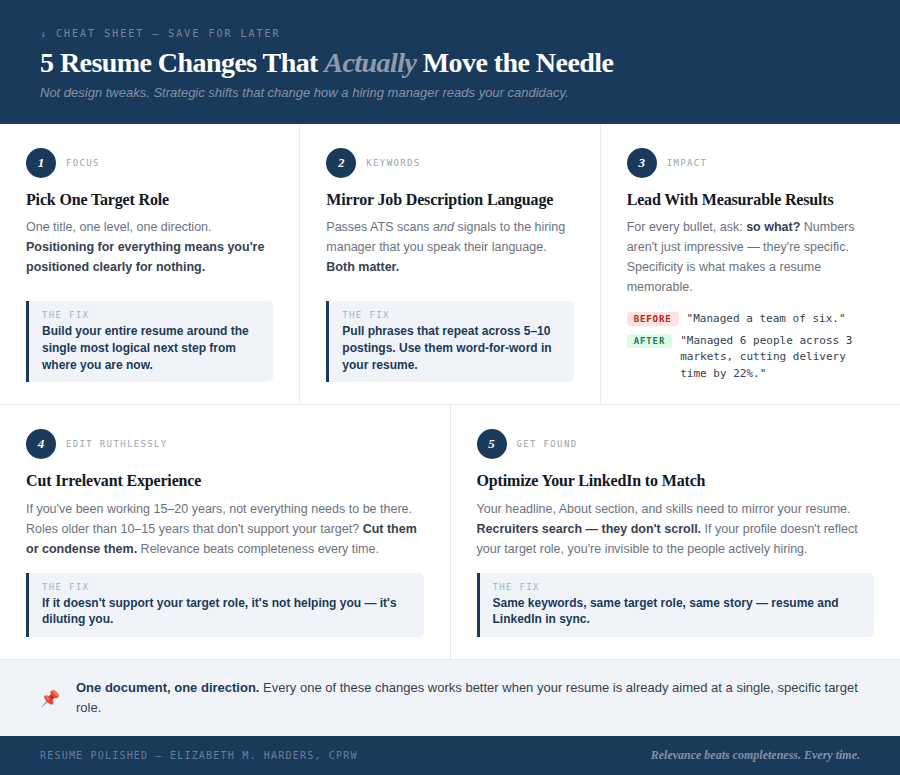
These are the five changes that consistently move the needle for the clients I work with. Not design tweaks. Not length debates. Strategic changes that shift how a hiring manager reads your candidacy.
1. Pick One Target Role
Everything on your resume should point toward one specific next step. Not a category of jobs. One title, one level, one clear direction. When you try to position yourself for multiple different roles with one document, you end up positioned clearly for none of them. Pick the role that is the most logical, strategic next step from where you are right now, and build your resume around that.
2. Mirror Job Description Language
Pull the exact language from job postings and use it in your resume. This accomplishes two things. It gets you through applicant tracking systems that are scanning for keyword matches. And it signals to the hiring manager that you understand the role and speak their language. Both matter.
3. Lead With Measurable Results
Go through every bullet point on your resume and ask one question: so what? "Managed a team of six" becomes "Managed a team of six across three markets, reducing project delivery time by 22 percent." "Handled customer escalations" becomes "Resolved an average of 30 customer escalations per week with a 94 percent satisfaction rating." Numbers are not just impressive. They are specific. And specificity is what separates a memorable resume from a forgettable one.
4. Cut Irrelevant Experience
If you have been in the workforce for fifteen or twenty years, not everything from the early part of your career needs to be on your resume. Roles from more than ten to fifteen years ago that are not relevant to your current target can be listed briefly or cut entirely. A tighter, more focused resume reads better and tells a clearer story than a full career chronology. Relevance beats completeness every time.
5. Optimize Your LinkedIn to Match
Your LinkedIn profile and your resume need to tell the same story. If your headline does not match the role you are targeting, recruiters searching for your exact role will not find you. Your About section, your experience descriptions, and your skills section should all be loaded with the same keywords you are using on your resume. This is how you get found by the recruiters who are actively hiring, even when you are not applying anywhere.
How to Get Hired Fast in a Competitive Market
Speed in a job search comes from strategy, not effort alone. You can send applications all day and stay stuck for months if the underlying strategy is off. Here is what actually accelerates the process.
Visibility Matters
If you are not showing up in recruiter searches, you are starting every opportunity at a disadvantage. Optimizing your LinkedIn profile for your target role is one of the fastest ways to increase visibility without changing how many applications you send.
LinkedIn Matters More Than Most People Think
A lot of professionals treat LinkedIn as a secondary document. A backup to the resume. It is not. Recruiters at the corporate level are searching LinkedIn daily. They are finding candidates who have never applied to their company. If your profile is not built around your target role, you are invisible to a significant portion of the hiring market.
Referrals Move Faster Than Applications
A referred candidate typically moves through the hiring process faster and with less friction than a cold application. If you have former colleagues, past managers, or alumni connections at companies you want to work for, reaching out directly and asking for a conversation is one of the highest-return moves you can make. Most people skip this because it feels uncomfortable. The ones who do it consistently get hired faster.
Resume Clarity Drives Callbacks
At the end of the day, the resume is the thing that gets you the conversation. If it is not generating callbacks, something is not landing. Either the positioning is off, the results are buried, or the language does not match what the employer is looking for. Fixing that one document changes everything downstream.
FAQ: How to Get Hired Fast
Should I customize my resume for every job?
You do not need to rebuild your resume from scratch for every application. What you should do is adjust your summary to match the role, mirror key phrases from the job description, and make sure your most relevant experience is easy to find. Those three changes take fifteen to twenty minutes and can significantly improve your response rate.
How do I get hired fast in corporate roles?
Focus on three things: a targeted resume that speaks directly to the role, a LinkedIn profile that is optimized with the right keywords, and direct outreach to your network rather than relying entirely on job boards. Corporate hiring at mid-to-senior levels moves faster when someone inside the company knows your name.
Does formatting really matter on a resume?
Yes, but not for the reasons most people think. Formatting matters because a clean, ATS-friendly layout ensures your content actually gets read. Design-heavy resumes with graphics or columns often get scrambled by applicant tracking software and never make it to a human. Keep it clean and simple so the content can do its job.

About Career Coach and Author
Hi, I’m Elizabeth Harders. I’m a former recruiter turned career strategist who has spent years on the other side of the hiring table. I’ve seen thousands of resumes and cover letters, some great, most forgettable. Now, I help professionals craft applications that actually stand out and lead to interviews.
My specialty? Helping ambitious professionals land six-figure roles at Fortune 500 companies. Whether it’s fine-tuning a resume, optimizing a LinkedIn profile, practicing for an interview, or crafting a powerful cover letter, I make sure my clients present themselves as the best possible candidate for the job they want.
If you’re tired of sending applications into the void, book a free career strategy session.
Key Takeaways
A broad resume that appeals to everyone gets responses from no one. One clear target role, built into every section, is what drives callbacks.
Bullet points without measurable results are just job descriptions. Hiring managers want to see what changed because of what you did.
You do not need ten different resumes. You need one strong core resume with targeted adjustments for each application.
LinkedIn and your resume need to match. If they tell different stories, you are creating confusion and losing opportunities you never even knew existed.
Getting hired fast is a positioning problem, not a volume problem. The fix is in the strategy, not the number of applications.
Ready to Get Your Resume Working for You?
If you want expert feedback on what is not landing and a clear plan to fix it, here are a few ways to work with Elizabeth:
Free Strategy Session: Book here
Career Coaching Program: Learn more
Resume Writing Services: See options