Why Your Resume Gets You Interviews for Jobs You Don't Actually Want
TL;DR: Getting more interviews is not the goal. Getting interviews at the right companies, for the right roles, at the right pay is. A resume without a clear target attracts attention from the wrong places and wastes time you do not have.
Most job seekers measure their search by activity. How many applications sent. How many responses received. How many interviews booked. The assumption is that more activity equals more progress, and that the offer will eventually come if you just keep going.
But there is a version of a job search that looks busy and productive on the surface while producing nothing close to what the person actually wants. Interviews with companies that pay below your target. Callbacks for roles that are a step backward. Conversations with employers whose culture, leadership style, or values are a clear mismatch before you even walk in the door.
If that sounds familiar, the problem is probably not your effort. It is your positioning. And your resume is likely the source of it.
More Interviews Are Not Always the Goal
It sounds counterintuitive because the job search often feels like a numbers game. More applications, more callbacks, more interviews, more chances at an offer. But an interview is only valuable if the opportunity on the other side of it is actually worth having.
I have worked with professionals who had no shortage of interviews. Their resume was generating responses and their inbox was active. But every conversation they were having was with the wrong type of company, for the wrong type of role, at compensation that did not reflect what they were actually worth. They were busy. They were not making progress.
The resume was doing its job of getting attention. It just was not attracting the right attention. That is a positioning problem, and it is one of the most common ones I see.

Your Resume May Be Attracting the Wrong Opportunities
Most resumes are built around what the person has done rather than where they are going. They list tasks, job titles, and responsibilities in reverse chronological order and hope the hiring manager connects the dots between that history and the role being filled.
The problem with that approach is that it is passive. It puts the interpretive work on the reader. And different readers will interpret the same resume differently depending on what they are looking for, which means a resume built around duties rather than direction will attract a wide range of opportunities, most of which will not be what you actually want.
A resume that shows direction, that signals the type of role, the level of responsibility, and the kind of impact the candidate is looking to make next, narrows that field in the right way. It attracts fewer irrelevant conversations and more relevant ones. That is what strategic positioning does.
A Better Resume Starts With a Better Target
Before I rewrite anything for a client, I need to understand what they are actually going after. Not in a vague sense. Specifically. What type of role. What industry or industries. What level of leadership. What kind of company culture. What compensation range. What kind of work environment makes them feel energized rather than drained.
That conversation is the foundation of everything that follows. Because the resume I build for someone targeting a VP of Operations role at a mid-size manufacturing company looks different from the one I build for someone targeting a Director of Marketing role at a growth-stage tech startup, even if both people have similar backgrounds.
Client Story: 10 Interview Opportunities and One Top-Choice Offer
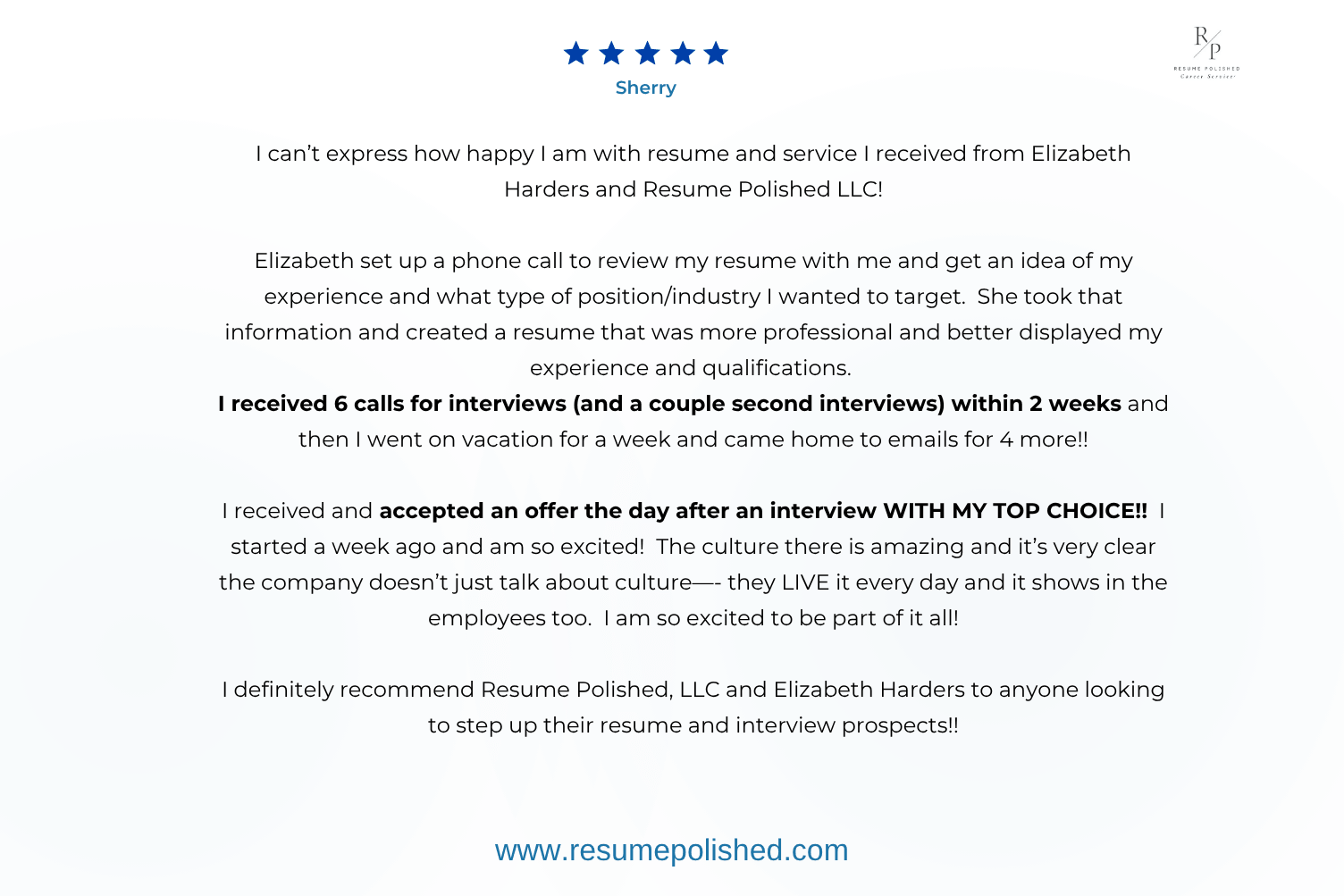
Sherry reached out because she was ready for something better. After a call where we reviewed her experience together and got clear on the type of role and industry she was targeting, I rebuilt her resume to reflect her actual qualifications in a way that spoke directly to the opportunities she wanted.
Two weeks later she had received six calls for interviews. A couple of those turned into second rounds. Then she went on vacation for a week and came home to four more emails waiting in her inbox.
She went on to accept an offer the day after an interview with her top-choice employer. She described the culture there as exceptional, not just as a talking point the company promotes, but as something she could see in the employees in her first week. She was excited in a way that a job offer does not always produce.
That is what a targeted resume strategy produces when it works. Not just more activity. The right activity, leading to the right offer, with a company she actually wanted to be at.
The Right Resume Does More Than Get Attention
There is a real difference between a resume that gets noticed and a resume that gets noticed by the right employer. The first one fills your calendar with conversations that go nowhere. The second one filters the field so that the conversations you are having are the ones worth having.
When your resume is positioned correctly, the employers who respond are already a closer match. The interviews feel different because the role is genuinely relevant. The offer, when it comes, reflects your actual value rather than what a company could get away with paying someone whose resume did not make their worth clear.
Better positioning also leads to better outcomes on the back end. Better pay because you were negotiating from a position of genuine fit. Better culture match because the companies attracted to your profile were aligned with what you were looking for. More confidence in your decision because you were not accepting out of exhaustion. You were accepting because it was actually right.
Sherry did not just get an offer. She got her top-choice offer. That distinction matters.
Why Job Seekers Need Strategy, Not Just Another Resume Template
A resume template gives you a structure. It does not give you a strategy. And for most professionals who are serious about their next move, structure is the least of their problems.
What actually produces consistent results is a full job search strategy that covers the complete picture. That means career positioning that clarifies your direction before anything gets written. A resume that reflects your value and attracts the right opportunities. A LinkedIn profile that makes you findable and credible to the recruiters and hiring managers who are actively looking for someone like you. A cover letter approach that reinforces your positioning rather than restating your resume. A job search strategy that goes beyond job boards and taps the networks and relationships where real opportunities actually live.
It also means interview preparation that helps you perform at the level you are claiming, and salary negotiation so you do not leave money on the table at the finish line. And it means accountability throughout the process so the strategy actually gets executed rather than sitting in a document somewhere.
That is what the bootcamp is built around. Not a better template. A complete approach to the job search that treats every piece as connected, because it is.
FAQ: Resume Strategy and Job Search
Why am I getting interviews but no offers?
This usually points to one of two things: either the interviews are with companies that are not the right fit and the lack of genuine alignment is showing up in the conversation, or the interview preparation has not caught up to the level of the roles you are pursuing. A resume that attracts the right opportunities needs to be paired with an interview approach that converts those opportunities into offers.
Should I apply to multiple types of roles to keep my options open?
At the mid-to-senior level, applying broadly with a general resume tends to produce exactly the problem described in this post: a lot of conversations that do not lead anywhere useful. A more focused strategy, one clear target role, and a resume built around it, typically generates faster and better results than keeping every option open with one document that speaks clearly to none of them.
What is the difference between a resume rewrite and career coaching?
A resume rewrite improves the document. Career coaching improves the strategy. For some people, the document is the main issue. For most, the document is one piece of a broader approach that also needs attention: clarity on direction, LinkedIn presence, networking, interview preparation, and negotiation. The two work best together.

About Career Coach and Author
Hi, I’m Elizabeth Harders. I’m a former recruiter turned career strategist who has spent years on the other side of the hiring table. I’ve seen thousands of resumes and cover letters, some great, most forgettable. Now, I help professionals craft applications that actually stand out and lead to interviews.
My specialty? Helping ambitious professionals land six-figure roles at Fortune 500 companies. Whether it’s fine-tuning a resume, optimizing a LinkedIn profile, practicing for an interview, or crafting a powerful cover letter, I make sure my clients present themselves as the best possible candidate for the job they want.
If you’re tired of sending applications into the void, book a free career strategy session.
Key Takeaways
More interviews with the wrong employers is not progress. Targeted positioning attracts the right conversations, not just more of them.
A resume built around tasks and duties attracts broad, unfocused interest. A resume built around direction and impact attracts the right employers.
Clarity on your target comes before the resume, not after. The intake process is where real strategy begins.
The right offer comes from the right positioning, not from exhaustion or desperation. Sherry did not just get an offer. She got her top choice.
Templates give you structure. Strategy gives you results. For most job seekers, it is the strategy that is missing.
Career Coaching and Bootcamp:Learn more
Resume Writing Services:See options
Free Strategy Session:Book here