Resume vs LinkedIn Profile: What Tells Your Career Story Better in 2026?
It's 2026. You can't just rely on a resume anymore, and LinkedIn isn't optional either.
But how are they actually different? Do you really need both? And if you're short on time, where should you focus first?
I've reviewed thousands of resumes and LinkedIn profiles over the years, and here's what I've learned: they work best when they do different jobs. One gets you through ATS systems. The other gets you found by recruiters before you even apply.
Most people treat their LinkedIn profile like a copy-paste version of their resume. That's a mistake. Or they ignore LinkedIn completely and wonder why recruiters never reach out. That's also a mistake.
I'm going to break down how your resume and LinkedIn profile work together, where they should differ, and how to make each one do what it's supposed to do.
The Purpose of a Resume vs a LinkedIn Profile
Your resume is for tailored applications. It's a document you customize for each role. You're showing a specific hiring manager why you're the right fit for their specific opening. It's targeted. It's precise. It's all business.
Your LinkedIn profile is for visibility and search. It's how recruiters find you when they're looking for someone with your skills. It's your professional presence online. It's broader, more conversational, and it stays consistent even when you're applying to different roles.
Think of it this way: your resume is a rifle. Your LinkedIn profile is a net. One hits a specific target. The other catches opportunities you didn't even know were out there.

How Recruiters Use Each Platform Differently
Recruiters use your resume to evaluate if you meet the job requirements. They're scanning for keywords, checking your experience against the job description, and deciding if you're worth a phone screen. It's a filtering tool.
They use your LinkedIn profile to validate that you're a real person, see your career trajectory, and get a sense of your professional brand. They're looking at your headline, your summary, and your recommendations. They're checking if you're active, if you're engaged in your industry, and if you seem credible.
I had a recruiter tell me she always checks LinkedIn after reviewing a resume. If someone's LinkedIn is outdated or nonexistent, it raises a red flag. Are they actively looking? Are they serious about their career? Do they understand how hiring works in 2026?
The importance of resume customization versus profile consistency is huge. You should be tweaking your resume for every application. You should not be constantly rewriting your LinkedIn profile. Your profile stays stable. Your resume adapts.
How Role Level Changes Which One Matters More
Here’s the part most career advice skips: The higher you go, the less the job search works like a form submission.
For individual contributor roles, resumes still carry the most weight because you’re applying through ATS systems.
For leadership, director, VP, and executive roles, LinkedIn often matters more. Many of these roles are never posted publicly. Recruiters search LinkedIn, build shortlists, and reach out directly.
That’s why senior candidates can’t rely on resumes alone. If you’re invisible on LinkedIn, you’re invisible to the hidden job market.
Where Your Resume Should Go Deeper
Your resume should include quantifiable results and metrics that prove your impact. "Increased sales by 40%" means something. "Responsible for sales" means nothing.
Every bullet point on your resume should answer: what did you do, how did you do it, and what was the result? If you can't answer all three, the bullet needs work.
I see resumes all the time that list responsibilities instead of accomplishments. "Managed a team of five." Okay, so what? Did the team improve? Did they hit targets? Did you turn around a struggling group? Give me the outcome.
How to tailor a resume for each job description is simple but time-consuming. You read the job posting. You identify the top three to five requirements. You make sure your resume clearly shows you have those things. You use the same language they use in the posting.
If they're asking for "stakeholder management," don't say "worked with cross-functional teams." Say "stakeholder management." ATS systems are looking for exact matches. Give them what they want.
Resume Bullets vs LinkedIn Summaries
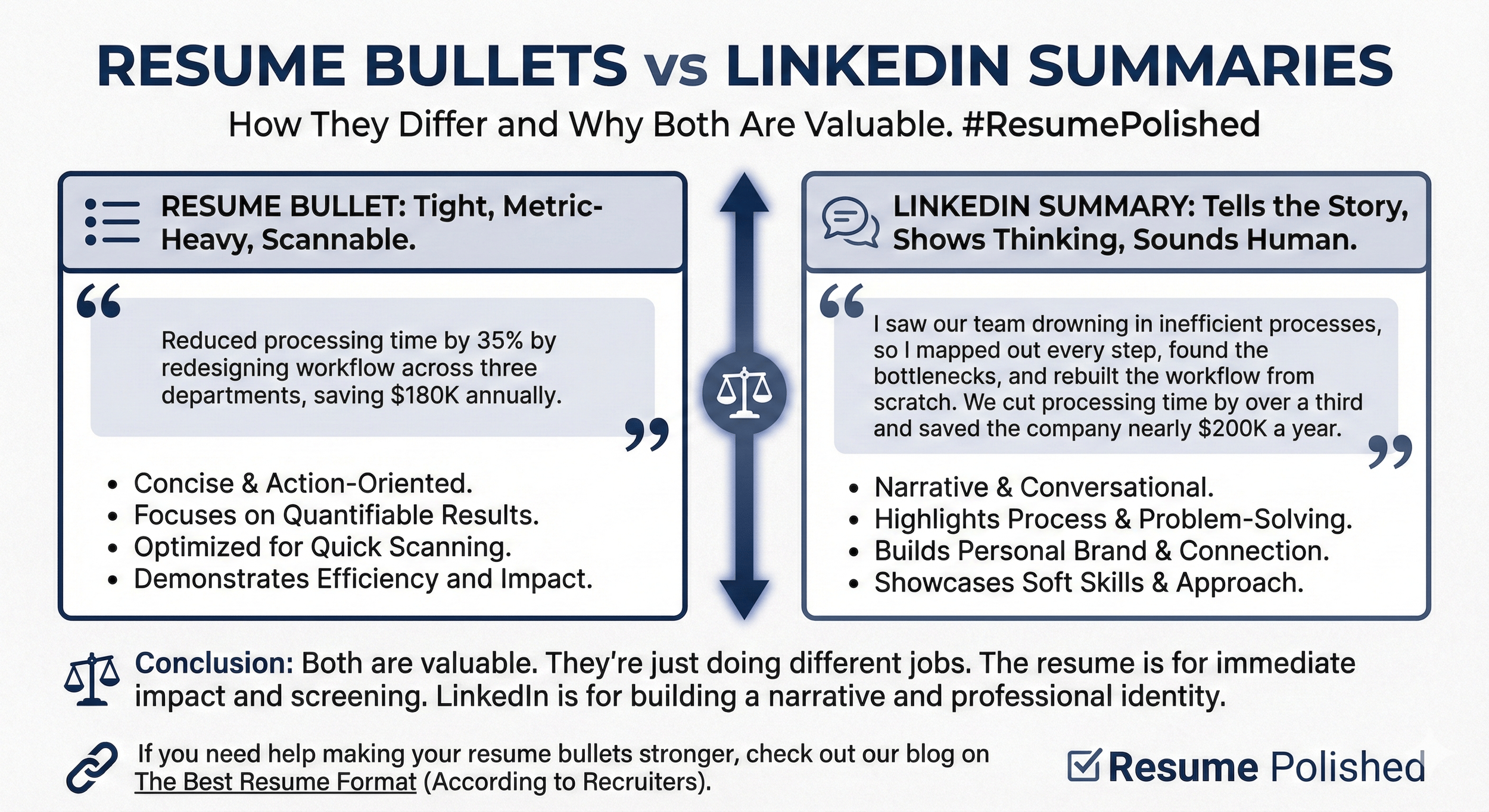
Here's an example of how they differ.
Resume bullet: "Reduced processing time by 35% by redesigning workflow across three departments, saving $180K annually."
LinkedIn summary of the same accomplishment: "I saw our team drowning in inefficient processes, so I mapped out every step, found the bottlenecks, and rebuilt the workflow from scratch. We cut processing time by over a third and saved the company nearly $200K a year."
See the difference? The resume is tight, metric-heavy, and scannable. The LinkedIn version tells the story, shows your thinking, and sounds human.
Both are valuable. They're just doing different jobs. If you need help making your resume bullets stronger, check out our blog on The Best Resume Format (According to Recruiters)
What Your LinkedIn Profile Should Do That Your Resume Doesn't
SEO and Searchability
SEO matters on LinkedIn in a way it doesn't on your resume. Recruiters search LinkedIn using keywords. If your profile doesn't have the right terms, you won't show up.
Your headline should include your role and key skills. Not just "Marketing Manager." Try "Marketing Manager | B2B SaaS | Demand Gen & Content Strategy." That's searchable. That tells recruiters exactly what you do.
Your summary should include the keywords recruiters are searching for, but woven into natural sentences. Don't keyword-stuff. Write like a human who happens to work in your field.
I've seen LinkedIn profiles with headlines like "Passionate professional seeking new opportunities." That's nice, but it's not searchable. Recruiters aren't typing "passionate professional" into the search bar. They're typing "product manager fintech" or "sales director healthcare."
Creating a Human Voice and Value Proposition
LinkedIn is where you get to sound like a person, not a resume robot. Your summary should explain who you are, what you're good at, and what you're looking for. First person. Conversational. Authentic.
"I've spent the last eight years building marketing programs that actually move the needle. I'm not interested in vanity metrics. I care about pipeline, revenue, and ROI. If you're scaling a B2B company and need someone who can connect marketing to business outcomes, let's talk."
That's a value proposition. It's clear. It's confident. It's human. You can't write like that on a resume, but you should on LinkedIn.
How to get noticed by recruiters through profile activity matters too. Posting occasionally, engaging with industry content, and keeping your profile updated signal that you're active and engaged. Recruiters notice that.
I had a client who started posting once a week on LinkedIn about supply chain challenges. Within a month, she had two recruiters reach out with roles she hadn't even applied for. That's the power of visibility.
If you're not sure how to optimize your LinkedIn profile for search, our professional LinkedIn optimization services can help you get found by the right recruiters.
What Should Match Across Both Platforms (And What Shouldn't)
Job titles and employment dates need to match exactly. If your resume says you were a "Senior Analyst" from 2020 to 2023, your LinkedIn better say the same thing. Recruiters compare. Discrepancies make you look dishonest or careless.
I've seen people inflate their titles on LinkedIn or fudge dates to cover gaps. Don't do it. If a recruiter catches you, you're done. The trust is gone.
Expand on LinkedIn, Condense on Your Resume
What to expand on in LinkedIn that you keep brief on your resume includes things like your career story, your "why," and your future direction. Your resume doesn't have space for that. LinkedIn does.
On your resume, you might have one line: "Project Manager, ABC Company, 2021-2024."
On LinkedIn, you can add context: "I joined ABC Company to lead their first major digital transformation project. Over three years, I built the PM function from scratch and delivered five enterprise-level implementations."
That context helps recruiters understand your trajectory. It shows growth. It shows intentionality.
How to avoid duplicating your resume word-for-word is simple: don't copy-paste. If your LinkedIn summary is just your resume bullets in paragraph form, you're wasting the platform. Rewrite it. Add personality. Tell the story behind the bullets.
How Recruiters Search and Compare Both
Recruiters use your resume to assess fit against the job requirements. They use your LinkedIn profile to assess credibility, culture fit, and career narrative.
LinkedIn often comes first because recruiters are proactively searching for candidates before roles are even posted. If your LinkedIn profile is strong, you might get contacted before you ever apply.
I know a recruiter who fills 60% of her roles through LinkedIn outreach. She's not waiting for applications. She's searching profiles, finding people who match, and reaching out directly. If your profile isn't optimized, you're invisible to her.
How strong LinkedIn content can supplement a lean resume matters for career changers or people with gaps. If your resume looks thin, your LinkedIn can fill in the blanks. You can explain transitions, add volunteer work, show certifications, and demonstrate ongoing learning.
A job seeker told me she had a two-year gap on her resume because she was caring for a family member. On LinkedIn, she included that context and also highlighted the consulting projects she did during that time. Recruiters saw the full picture, not just the gap.
If you're struggling to make both your resume and LinkedIn work together, our resume writing services include LinkedIn optimization to make sure your story is consistent and compelling across platforms.

About Career Coach and Author
Hi, I’m Elizabeth Harders. I’m a former recruiter turned career strategist who has spent years on the other side of the hiring table. I’ve seen thousands of resumes and cover letters, some great, most forgettable. Now, I help professionals craft applications that actually stand out and lead to interviews.
My specialty? Helping ambitious professionals land six-figure roles at Fortune 500 companies. Whether it’s fine-tuning a resume, optimizing a LinkedIn profile, practicing for an interview, or crafting a powerful cover letter, I make sure my clients present themselves as the best possible candidate for the job they want.
If you’re tired of sending applications into the void, book a free career strategy session.
FAQs: Resume vs LinkedIn Profile
-
Yes. Your resume is required for applying to jobs through ATS systems. Your LinkedIn profile helps you get found by recruiters, validates your credibility, and builds your professional brand. You need both working together.
-
You can, but you shouldn't. LinkedIn summaries work better when they're written in first person, explain your "why," and include your future goals. Resume summaries are third person and focused on what you've already done. Rewrite it for LinkedIn.
-
Both matter, but for different reasons. Your resume is what gets you through ATS and initial screening. Your LinkedIn profile is what recruiters use to find you proactively and validate that you're credible. Ignore either one and you're limiting your opportunities.
Let Your Career Story Work for You, Not Against You
In 2026, the best job seekers aren't choosing between a resume or LinkedIn. They're making both work together.
Your resume gets you through the door. Your LinkedIn profile builds credibility and helps you get found before you even know a role exists.
I've seen too many qualified people miss opportunities because their LinkedIn was outdated or their resume wasn't tailored. And I've seen people with okay experience get great roles because they understood how to use both platforms strategically.
If you haven't touched your resume or LinkedIn in a while, now's the time. Update your LinkedIn headline with searchable keywords. Rewrite your summary to sound human. Make sure your resume shows quantifiable results and is tailored for the roles you want.
And if you're not sure where to start, our professional resume writing services can help you build both a resume and a LinkedIn profile that tell your story clearly and get you noticed by the right people.
Your career story should open doors, not close them. Make sure both your resume and LinkedIn are doing their jobs.