How to Talk About Yourself Confidently in Interviews (Without Sounding Rehearsed)
"Tell me about yourself."
It's usually the first question, and one of the hardest to answer without rambling, freezing up, or sounding like a robot reading a script.
I've sat through interviews where job seekers nailed every technical question but completely fumbled this one. I've also coached hundreds of clients through this exact moment, and here's what I've learned: how you talk about yourself sets the tone for the entire interview.
The most confident people weren't always the most experienced. They were the most prepared. They had a structure. They practiced without over-rehearsing. They sounded like themselves, just the polished version.
I'm going to break down how to talk about yourself in interviews with confidence, authenticity, and a framework that gets the hiring manager leaning in instead of checking their phone.
Why This Question Feels So Awkward (And Why It Matters)
The question feels like an invitation to talk about anything. Your childhood. Your hobbies. Your career journey from day one. But that's not what interviewers want.
It's open-ended, but interviewers have a clear expectation. They want to know who you are professionally, why you're here, and if you can communicate clearly under pressure. That's it.
Many candidates default to listing their resume. Don't do that. The interviewer has already read your resume. They don't need you to repeat it line by line. They want context. They want your story. They want to understand your trajectory.
Your response sets the energy and shapes how you're remembered. If you come across as confident and clear, they assume you'll be confident and clear on the job. If you ramble or sound unsure, that's the impression that sticks.
One hiring manager told me she decides within the first two minutes if someone is a strong communicator. This question is where she makes that call.
The 3-Part Framework for Answering "Tell Me About Yourself"
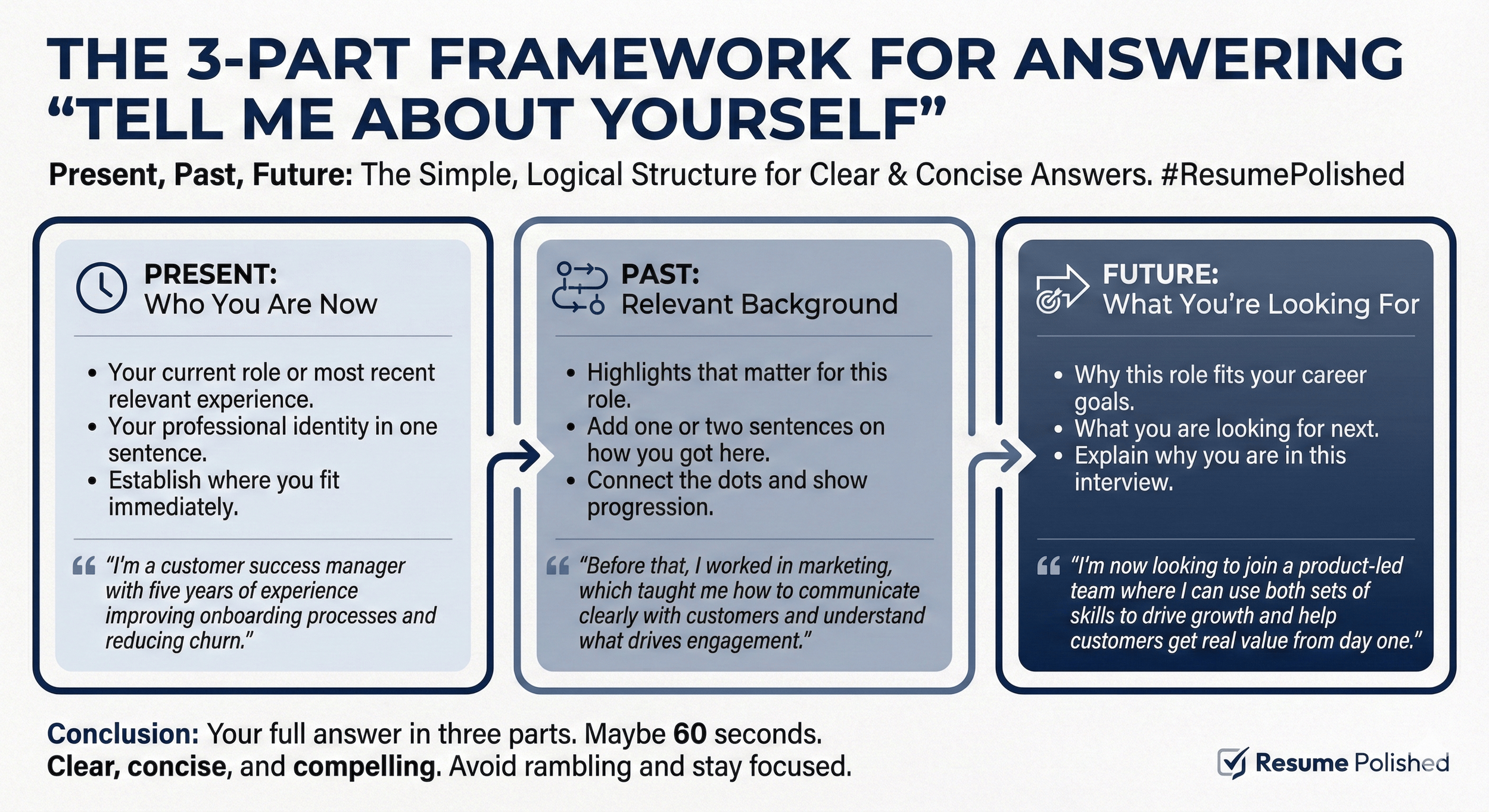
Present, Past, Future
This is the structure that works every single time. It's simple. It's logical. It keeps you from rambling.
Present: Who you are professionally right now. Start with your current role or your most recent relevant experience. Give them your professional identity in one sentence.
"I'm a customer success manager with five years of experience improving onboarding processes and reducing churn."
That's it. You've told them what you do and what you're good at. They know where you fit.
Past: Relevant background or experience that led you here. This is where you add one or two sentences about how you got to where you are. Don't go back to high school. Just hit the highlights that matter for this role.
"Before that, I worked in marketing, which taught me how to communicate clearly with customers and understand what drives engagement."
You're connecting the dots. You're showing progression. You're proving this isn't random.
Future: What you're looking for and why this role fits. Close by explaining why you're sitting in this interview. What are you looking for next? Why does this opportunity make sense?
"I'm now looking to join a product-led team where I can use both sets of skills to drive growth and help customers get real value from day one."
That's your full answer. Three parts. Maybe 60 seconds. Clear, concise, and relevant.
A Real Example
Here's how it sounds all together:
"I'm a financial analyst with six years of experience helping mid-size companies improve forecasting accuracy and streamline reporting. I started in accounting, which gave me a strong foundation in the numbers, but I realized I was more interested in using data to guide strategy. That's why I moved into FP&A. I'm now looking for a role where I can work closely with leadership to support decision-making, which is exactly what drew me to this position."
That's confidence. That's clarity. That's someone who knows their story. If you need help crafting your story with the same kind of structure, our interview coaching services can help you practice until it feels natural.
How to Practice Without Sounding Scripted
Write your answer out first. Get all your thoughts on paper. Then rewrite it shorter and simpler. Cut the corporate jargon. Cut the filler words. Make every sentence earn its place.
If you're using words like "synergistic" or "leveraged" or "facilitated," stop. Talk like a human. Imagine you're explaining your career to a friend over coffee. That's the tone you want.
Record Yourself Speaking It Conversationally
This is the step most people skip, and it's the most important one. Record yourself saying your answer out loud. Then listen back.
You'll hear things you don't notice in your head. You'll catch where you ramble. You'll hear if you sound robotic. You'll notice if you're talking too fast or using too many filler words.
I had a client who thought she sounded great until she recorded herself. She said "um" 14 times in 90 seconds. She had no idea. Once she heard it, she fixed it.
Practice With Someone Who'll Give Honest Feedback
Practice with a friend or coach who can give you real feedback. Not someone who'll just say, "That was great!" You need someone who'll tell you when you're rambling or when you've buried the most important part.
Ask them: Did I sound confident? Was it clear? Did I lose you anywhere? Did I sound like myself or like I was reading a script?
The goal isn't perfection. The goal is preparation that lets you be flexible. You know your structure. You've practiced the key points. But you're not locked into exact wording. That's how you sound rehearsed without sounding scripted.
If you want professional feedback on your interview answers before the big day, check out our mock interview practice sessions, where you get real-time coaching on how to improve.
What Interviewers Are Really Listening For

It's Not Just What You Say
Interviewers are listening for three things when you answer this question.
Clarity: Can you communicate under pressure? If you can't clearly explain who you are and what you do, they assume you'll struggle to communicate on the job. This is especially true for roles that involve presenting, writing, or client interaction.
Confidence: Do you believe in your own value? Confidence doesn't mean arrogance. It means you can talk about your skills and experience without downplaying them or apologizing for them. If you don't sound convinced you're qualified, why should they be?
Relevance: Are you aligned with the job and company goals? Your answer should make it obvious why you're here. If they're hiring for a project manager and you spend two minutes talking about your sales background without connecting it to project management, you've lost them.
One recruiter told me she can tell within the first minute if someone actually wants the job or if they're just going through the motions. Your answer to this question is where she figures that out.
What to Avoid When Talking About Yourself
Don't list every job you've ever had. You don't need to walk them through your entire career history. Hit the relevant highlights. Two or three key points max.
Don't start with "Well, I was born in..." unless it's directly relevant to the role. I've heard people start with their childhood interests or where they grew up. Unless you're applying to work in your hometown and local connection matters, skip it. Get to the professional stuff fast.
Don't self-deprecate or downplay your achievements. "I'm not sure if this is relevant, but..." or "I know I don't have as much experience as others, but..." Stop. You're undermining yourself before they've even formed an opinion.
I had a client who kept saying, "I'm still learning" every time she talked about a skill. It made her sound uncertain, even though she was qualified. We reframed it to "I'm always looking to grow in this area," which sounds proactive, not insecure.
Don't memorize a script word-for-word. If you've memorized it exactly, you'll freeze if you forget a word or if the interviewer interrupts. Know your structure. Know your key points. Let the exact wording be flexible.
A job seeker once told me she practiced her answer 50 times until she had it perfect. Then, in the actual interview, the hiring manager asked, "So what brings you here today?" instead of "Tell me about yourself." She panicked because it wasn't the exact question she'd prepared for. Don't be that person.
Bonus: Talking About Yourself When You're Changing Careers
Career changers struggle with this question because they're worried about sounding scattered or unqualified. But you can turn your transition into a strength if you frame it right.
Emphasize transferable skills over job titles. Don't get hung up on the fact that your last role was in a different field. Focus on the skills that carry over.
Frame your story around solving problems and learning fast. Show that you're someone who figures things out, who adapts, who brings fresh perspective.
Here's an example: "While my background is in education, I've always worked on data projects—tracking student outcomes, building tools to improve processes, and finding efficiencies. That's why I'm pivoting into operations. I want to apply those same problem-solving skills in a business environment where I can have a broader impact."
See how that works? You're not hiding your background. You're connecting it to the new role in a way that makes sense.
One client came from retail management and was applying for HR roles. We reframed her answer to focus on employee development, conflict resolution, and performance management—all things she did in retail that directly applied to HR. She got the job.
If you're changing careers and need help positioning yourself, our corporate resume writing services include strategic messaging that makes your transition clear and compelling.
FAQs: How to Talk About Yourself Confidently in Interviews
-
Keep it under 90 seconds. Around four to six sentences is usually enough. You're aiming for a summary, not your entire career history. If you go longer than two minutes, you're probably rambling.
-
You should rehearse it, but not memorize it word-for-word. Focus on the structure (present, past, future), and let your natural tone and personality come through. If you sound like you're reciting, you'll come across as robotic.
-
You don't need to brag. Just share what you're good at and how you've helped in the past. Use facts, not fluff. Talk about specific projects or results. Confidence grows the more you rehearse out loud, especially in a safe environment where you can make mistakes.

About Career Coach and Author
Hi, I’m Elizabeth Harders. I’m a former recruiter turned career strategist who has spent years on the other side of the hiring table. I’ve seen thousands of resumes and cover letters, some great, most forgettable. Now, I help professionals craft applications that actually stand out and lead to interviews.
My specialty? Helping ambitious professionals land six-figure roles at Fortune 500 companies. Whether it’s fine-tuning a resume, optimizing a LinkedIn profile, practicing for an interview, or crafting a powerful cover letter, I make sure my clients present themselves as the best possible candidate for the job they want.
If you’re tired of sending applications into the void, book a free career strategy session.
You Know More Than You Think, Now Show It
Interview confidence doesn't come from winging it. It comes from knowing what matters, having a structure, and practicing in a way that still feels like you.
I used to think I could just show up and figure it out in the moment. That's how I bombed interviews early in my career. Once I started preparing with a framework, everything changed. I sounded clearer. I felt more confident. I got better responses.
The more you prepare, the easier it becomes to talk about yourself with impact and clarity. You're not memorizing a script. You're building a flexible structure that lets you be yourself under pressure.
And if you want help practicing your story before the big day, our interview coaching sessions give you real-time feedback so you can refine your message and walk into that interview ready.
You've got the experience. You've got the skills. Now make sure you can talk about them in a way that gets you the offer.